The Physical Greeting That Nobody Agreed On: A Survivor's Guide to Saying Hello in America
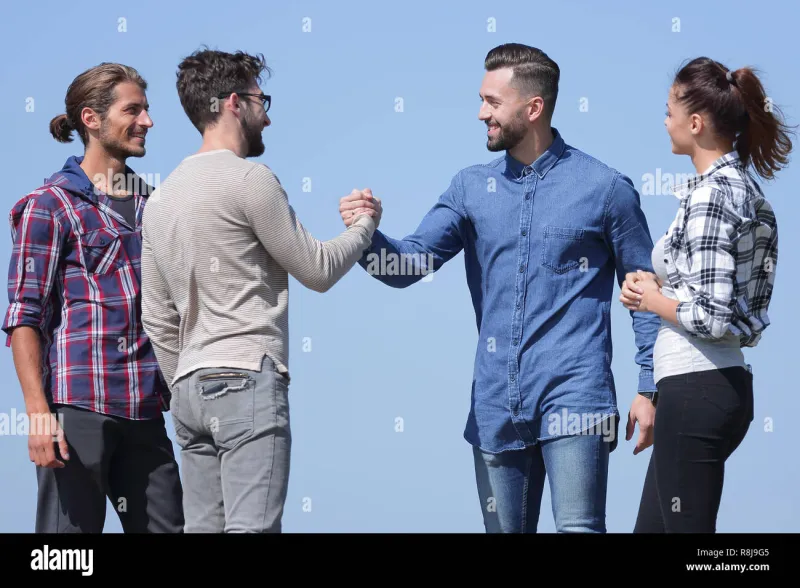
Photo: awkward handshake greeting friends social encounter, via c8.alamy.com
The Physical Greeting That Nobody Agreed On: A Survivor's Guide to Saying Hello in America
Somewhere between your first handshake lesson and right now, the American greeting system quietly collapsed. Nobody announced it. There was no memo. One day we were all confidently extending our right hands, and the next we were standing in someone's driveway doing a full-body hesitation dance while trying to determine whether this was a hug situation, a wave situation, or a mutual decision to simply acknowledge each other from a safe distance and call it good.
We have never recovered.
The Handshake Is Technically Still a Thing
In professional settings, the handshake survives. But even here, the ground has shifted. You approach a new colleague at a work event, hand already beginning its forward trajectory, and you watch their face cycle through three emotions in under a second: recognition, calculation, and commitment. They extend their hand. You make contact.
Now comes the grip calibration. Too firm and you're a LinkedIn caricature. Too loose and you've handed someone a dead fish with a smile. You go for confident-but-approachable, which is a grip strength that does not technically exist, and you hold it for exactly one beat longer than either of you expected.
You say great to meet you in perfect unison, which is somehow worse than not saying it at all.
The Cookout Encounter: A Case Study in Escalating Confusion
The backyard cookout is where greeting theory completely breaks down. You arrive. Your host is across the yard. They see you. You see them. You are now committed to a greeting, but you are separated by forty feet of lawn, two folding tables, and a man with tongs who doesn't realize he's standing in the path of your social transaction.
You wave. They wave. You begin walking toward each other. By the time you arrive, you have both exhausted the wave and must now determine what comes next. The hug feels right — you've known each other for years — but they've got a beer in one hand and a paper plate in the other, which means any hug will be asymmetrical and slightly dangerous. You go for the side-shoulder-pat maneuver, which is not a real greeting so much as a physical acknowledgment that you are both standing in the same location.
"You made it!" they say.
"I made it," you confirm.
Nobody is sure what just happened.
The Fist Bump and Its Discontents
The fist bump entered mainstream culture as a clean, efficient alternative. Minimal contact. No grip calibration. No asymmetry issues. Simple geometry. Two fists. Done.
Except nobody can agree on the follow-through. Some people bump and retract immediately. Others bump and then open their hand into a finger-spread explosion, which apparently means something but you've never been sure what. A concerning number of people have started doing a bump-to-handshake hybrid that requires three sequential movements and a level of coordination that should not be necessary just to say hello to your coworker on a Monday.
You attempted the explosion follow-through once. The other person had already retracted. Your fingers spread into empty air. You made a small sound and looked at your hand like it had done something without your permission.
The Neighbor Gas Station Situation
This is the scenario with the highest awkwardness-per-second ratio of any greeting environment. You pull in for gas. Your neighbor pulls in across from you. You make eye contact through two windshields. This is the moment — the exact moment — where the greeting decision must be made, and you have approximately zero seconds to make it.
You wave from inside your car. They wave from inside their car. This should be enough. This is clearly enough. And yet one of you is going to get out of your car, and the other is also going to get out of their car, and now you're both standing on opposite sides of gas pumps trying to determine whether to walk around and actually interact or just continue waving from slightly closer range.
You end up having a full conversation across the pumps, half-shouting over the ambient noise of the parking lot, neither of you willing to physically close the distance because doing so would require another greeting decision at the end of the conversation when you leave.
The Goodbye Is Actually Worse
Everything discussed above is a warmup for the real event: the departure. Goodbyes require a greeting and a finality, which means you need to successfully execute a physical farewell while also communicating that you are actually leaving and not just repositioning.
You say goodbye. You hug, or fist bump, or wave, depending on what the opening established as precedent. You begin walking away. They say something. You turn back. Do you re-greet? Do you just answer the thing they said? You answer the thing. You say goodbye again. You leave.
You get to your car and realize you said "you too" when they said "drive safe." This is fine. This is normal. This happens to everyone.
You have been greeting people your entire life. You are no better at it than you were at age seven. The only difference is that now you understand, with full adult clarity, that nobody else knows what they're doing either — and that shared confusion is, in its own strange way, the most honest greeting of all.
Yep, that's a thing.