One Small Lie to a Server and Now You've Eaten the Same Bad Chicken Sandwich for Two Years
One Small Lie to a Server and Now You've Eaten the Same Bad Chicken Sandwich for Two Years
It started with four words: "Everything was great, thanks."
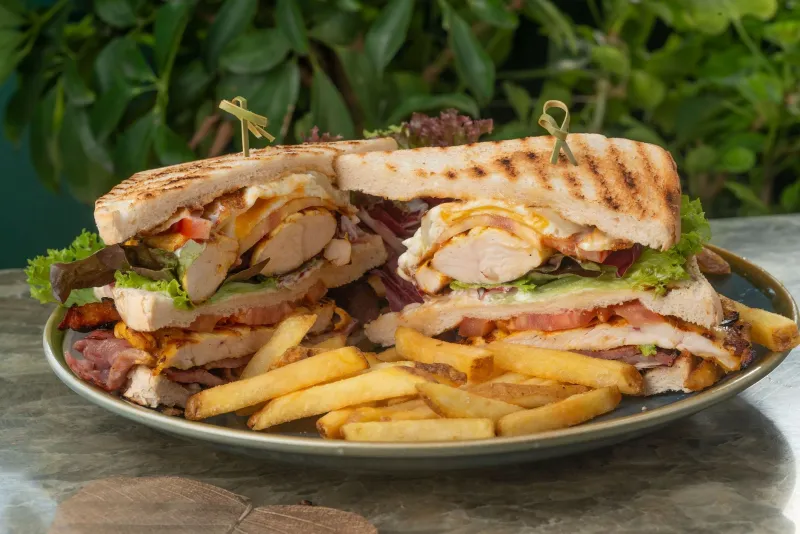
The chicken sandwich was not great. The chicken sandwich was, by any objective culinary measure, a disappointment — aggressively dry in a way that suggested the kitchen had a personal grievance against moisture, served on a brioche bun that was somehow both stale and soggy simultaneously, accompanied by fries that had clearly peaked about eight minutes before arriving at your table. You knew it. The server probably knew it. The table next to you, who watched you take one bite and visibly recalibrate your expectations, definitely knew it.
And yet.
"Everything was great, thanks."
Congratulations. You have just entered a social contract with no exit clause.
The Anatomy of the Original Lie
Let's be fair to yourself for a moment, because you didn't do this out of malice. You did it because the server seemed nice, and because they asked with genuine enthusiasm, and because the true answer — "honestly, the chicken was pretty dry and I think the fries sat under a heat lamp for a while" — felt like an aggressive amount of honesty to deploy on a Thursday lunch.
So you said it was great. You smiled. They said "awesome, so glad to hear it." You paid, left a 20% tip as a form of emotional compensation, and walked out into the sunlight feeling like a person who had successfully navigated a social interaction.
You did not consider the downstream consequences.
The Return Visit
A month later, you're back. Same place, different occasion — a work lunch, maybe, or a friend suggested it, or it's just the closest thing to your office and you've already mentally committed before you remembered. You sit down. You open the menu.
The menu has many items. You have not tried most of them. Some of them look genuinely good. The salmon looks promising. The grain bowl has received what appears to be a thoughtful amount of roasted vegetables.
But here's the thing: you told someone here — possibly this exact server, who you now recognize and who appears to recognize you — that the chicken sandwich was great. If you order something different, you are implicitly admitting that the chicken sandwich was not, in fact, great. You are retroactively calling yourself a liar. In front of a witness.
You order the chicken sandwich.
It is still dry.
The Compounding Problem
This is where behavioral economists would have a field day, and where you are simply having a bad time.
Each visit compounds the previous one. You are now two chicken sandwiches deep into a narrative that you cannot revise without a level of social awkwardness that feels disproportionate to the original crime. You have, through a series of individually rational but collectively catastrophic decisions, backed yourself into a corner made entirely of mediocre poultry.
By visit four, you have started to gaslight yourself. Maybe it's actually fine, you think, as you chew with the energy of someone completing a mandatory task. Maybe I just had it on a bad day the first time. This is the sunk cost fallacy wearing a brioche bun. You recognize it. You order it anyway.
By visit five, you have started ordering it with modifications — extra sauce, add avocado, swap the fries for a side salad — in an elaborate attempt to engineer your way to a good experience while technically still ordering the same item. The server writes it down without comment. You have become a regular. You are a regular who always orders the chicken sandwich. This is your identity here now.
The Mythology Expands
Somewhere around visit six, something worse happens: you recommend the restaurant to someone.
You don't mean to. It just comes up naturally in conversation — someone asks if you know a good spot nearby, and this place is nearby, and you've been there enough times that recommending it feels logical. "Yeah, I go there pretty often," you say, which is true. "The chicken sandwich is solid," you add, which is a lie so well-rehearsed at this point that it no longer registers as one.
Your friend goes. Your friend orders the chicken sandwich on your recommendation. Your friend reports back that it was "fine, I guess" with the specific energy of someone who was expecting more. You nod sympathetically. You do not confess. You are in too deep.
The Theoretical Off-Ramp
At some point, you develop a fantasy about the clean break. You'll go back, you'll order something different, and if anyone notices — which they won't, because servers are busy humans with many tables and not a detailed log of your ordering history — you'll simply say you were in the mood for something new. This is completely normal. People order different things all the time. There is no reason this needs to be a whole thing.
You go back. You open the menu. You look at the salmon.
Your server arrives. "Hey, welcome back! The usual?"
The usual.
You have a usual.
"Yeah," you say. "The chicken sandwich."
The Exit Strategy Nobody Has Figured Out
Here's the honest truth: there is no clean resolution to this. The only real options are to keep ordering the sandwich indefinitely, to stop going to the restaurant entirely and let the relationship end naturally like a magazine subscription you just stop renewing, or to order something different and simply accept the thirty seconds of mild awkwardness that will follow.
Option three is obviously correct. Option three is what a psychologically healthy person would do without a second thought.
You'll probably go with option two.
The salmon will never know what it missed.
Yep, that's a thing.